What Is Permeable Paving? Key Benefits and Common Use
What is permeable paving?
It’s a surface that lets rainwater drain through it instead of running off the top. The water passes through tiny pores or gaps, collects in a layer of stone underneath, and then either soaks into the ground or trickles away slowly to a drain.
That’s the whole idea. A driveway that doesn’t flood, a front garden that doesn’t turn into a river, and a bit less strain on the drains outside your house.
If you live in West Yorkshire, you’ve probably watched a puddle sit at the bottom of a drive for days. Permeable paving is one of the best fixes for that. Here’s how it works, which types are out there, where it makes sense, and the downsides that don’t always get mentioned.
Key Takeaways
- Permeable paving drains rain through the surface rather than across it.
- The stone layers underneath do most of the work, so the build quality matters as much as the finish you pick.
- Common options are permeable block pavers, porous asphalt, resin bound, gravel and grid systems.
- In England, a permeable driveway usually avoids the planning permission needed for large impermeable ones.
- It’s low maintenance, but not no maintenance, and it suits some types of ground better than others.
Understanding Permeable Paving
Think about a normal solid driveway. Rain lands, has nowhere to go, and runs off into the road and the gullies. That’s fine for one house. Multiply it by every house on the street and the drains can’t keep up, which is how surface water flooding starts.
Permeable paving flips this around. It deals with rain right where it falls. In the UK this approach is called SuDS (Sustainable Drainage Systems), which just means drainage designed to work more like natural ground.
You’ll also come across the terms porous paving and permeable surfaces. They overlap, but here’s the simple difference:
|
Type |
How water gets through |
Typical examples |
|
Porous paving |
Water passes through the material itself |
Porous asphalt, gravel, some resin bound surfaces |
|
Permeable block paving |
Water drains through the gaps between blocks |
Permeable block pavers |
|
Impermeable paving |
Water runs off unless drainage is added |
Standard concrete, conventional tarmac |
In practice, people use “permeable” as the umbrella word, and that’s fine. What matters is that water has somewhere to go.
How Permeable Paving Works
The surface is just the part you see. Underneath, a permeable driveway is built in layers:
- The surface. Permeable block pavers, porous asphalt, resin bound stone or gravel in a grid. This is where the rain gets in.
- The laying course. A thin bed of clean, angular stone. It holds everything in place and still lets water pass. It isn’t building sand, which would clog up.
- The sub-base. A deep layer of crushed stone with lots of gaps. Picture a hidden reservoir that holds rainwater for a while.
- A geotextile membrane (often). A permeable fabric that stops soil creeping up into the stone.
What happens next depends on your ground:
- Full infiltration: the water soaks into the soil.
- Partial infiltration: some soaks away, and the rest leaves through a controlled outlet.
- Attenuation (a tanked system): on clay or other slow-draining soil, the sub-base stores the water and releases it gradually.
Either way, the rain doesn’t rush off all at once. It’s held, filtered and let go slowly. That’s the same job nature does on a lawn or a woodland floor.
Types of Permeable Paving
There’s no single “permeable” product. These are the ones we’re asked about most.
Permeable block pavers
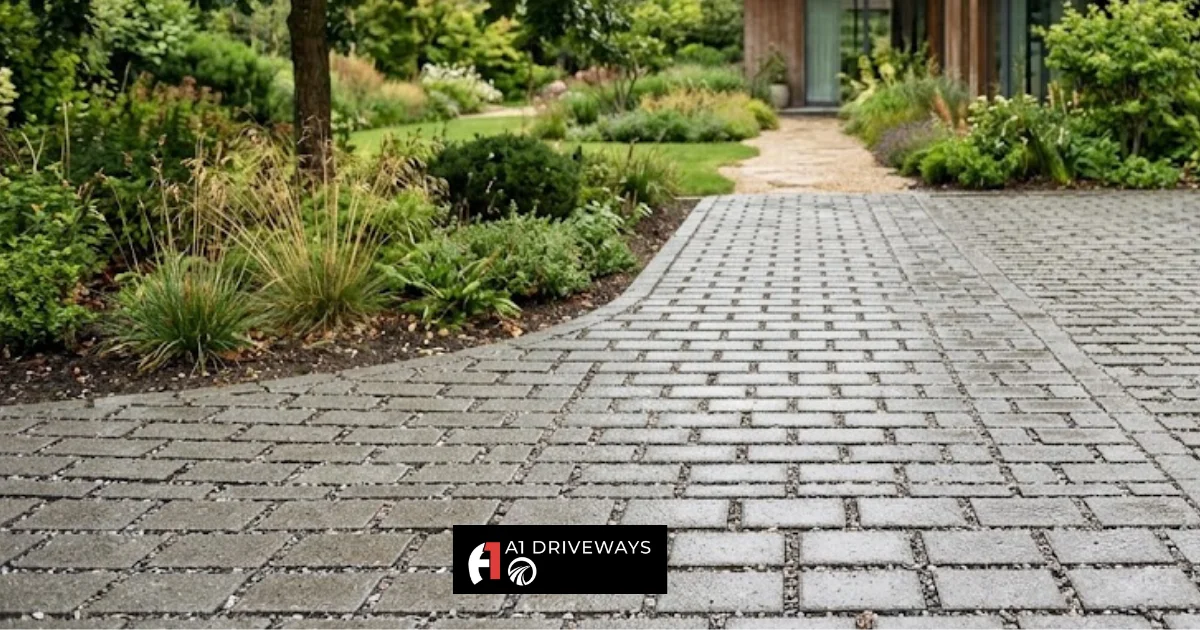
They look like traditional block paving, but the joints are wider or have built-in spacers, and they’re filled with small angular stone rather than sand. Water drains down through the joints. They suit period homes, and the blocks can be lifted and relaid if you ever need to get underneath.
Porous asphalt
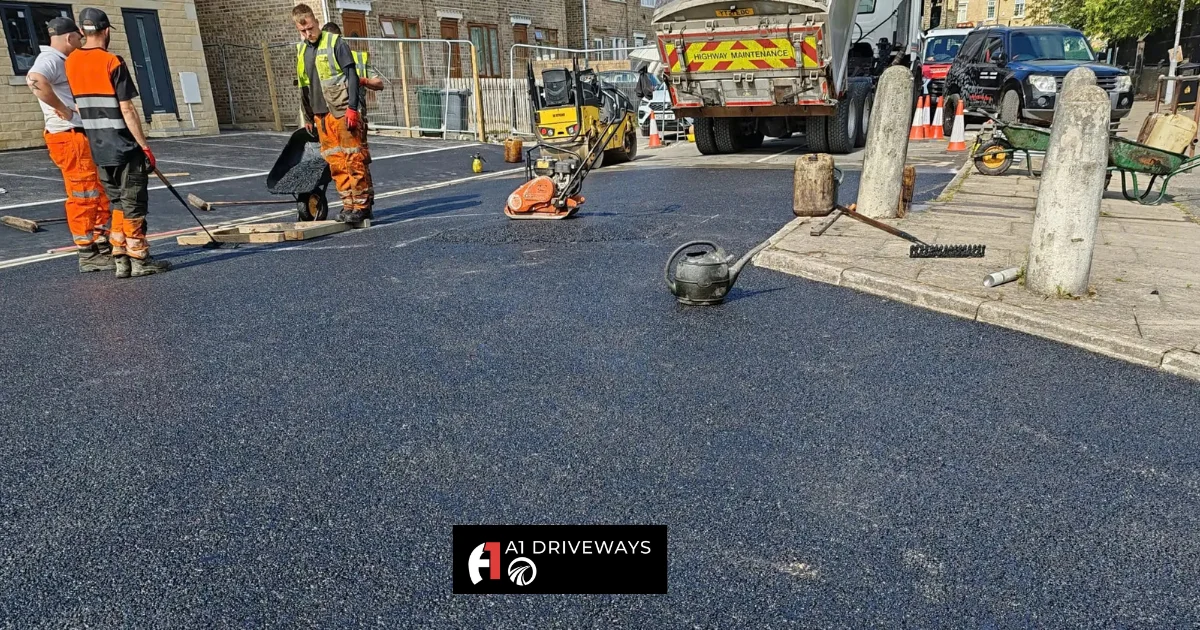
Tarmac made without the fine particles, so little voids stay open. It’s quite different from a standard tarmac driveway, which isn’t permeable.
We’ve covered that in our post on whether tarmac is permeable.
Resin bound
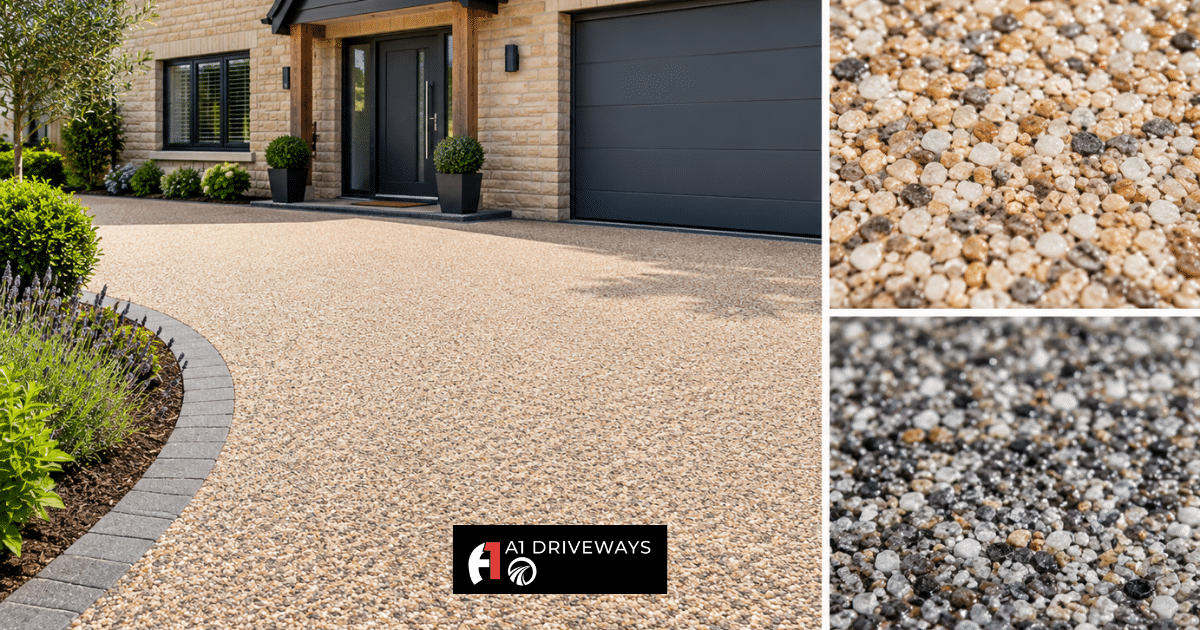
Natural stone mixed with clear resin and trowelled smooth. It can be permeable, but only if the base underneath is porous as well. Also watch the wording: resin bound is the porous one, whereas resin bonded (loose stone scattered over resin) usually isn’t. If you’re considering it, see our resin bound driveways.
Gravel
One of the oldest permeable surfaces and often the most budget-friendly. With a plastic grid underneath, it stays put instead of ending up on your lawn. See our gravel driveways.
Grass and concrete grid systems
Cells that let grass grow through while still taking a car’s weight. Great for overflow parking, less so for a daily drive.
Porous concrete
Concrete without the fine sand. You’ll mostly see it on commercial and public projects.
Key Benefits of Permeable Paving
Reduced Flooding Risk
Rain soaks in where it lands, so less of it hits the road and the public drains. One driveway helps a little. A whole street of them helps a lot.
Fewer Puddles
Standing water is a slip risk in the wet and an ice risk in winter. A driveway permeable surface stays clearer on top, so it dries faster and feels safer underfoot.
Natural Filtration
As water moves down through the stone, it leaves behind a lot of the grit, oil and fine dirt washed off cars and roads. Cleaner water reaches the ground, which is good news for local streams and rivers.
Easier Planning
Going permeable can save you the planning headache. More on that in the next section.
Healthier Soil and Gardens
Letting water return to the ground helps recharge groundwater and keeps nearby trees and planting happier, especially in a dry summer. A solid slab can’t do that.
Long-Lasting Strength
Done properly, a permeable build is tough. The deep stone base spreads weight well, so it copes with everyday car use.
Do You Need Planning Permission for a Driveway?
This is one of the first questions we hear, and the answer is often good news.
In England, you generally don’t need planning permission for a new or replacement driveway if you use a permeable or porous surface, such as gravel, permeable block paving or porous asphalt. You can also avoid it if the rainwater runs off to a lawn, border or soakaway within your property.
Where people get caught out is paving more than 5 square metres of front garden with an impermeable surface that has nowhere to drain. That usually does need permission.
A few things to keep in mind:
- Rules differ in Wales, Scotland and Northern Ireland.
- Listed buildings and conservation areas can have extra restrictions.
- Some councils and new-build estates set their own drainage conditions.
- A new vehicle access may need a dropped kerb.
Always check with your local council before work starts. We’re happy to talk it through at the free site visit, but we’re not a replacement for your council’s word.
Applications of Permeable Paving
Driveways
This is where most homeowners meet permeable paving. It handles daily car use, keeps rainwater on your property and works with block paving, resin bound and gravel, so you’re not stuck with one look.
Footpaths and Garden Paths
Paths stay drier and less slippery, and they sit nicely alongside planting. Good for front-door paths, side access and garden routes.
Patios
A permeable patio drains toward the ground rather than toward your house walls. That helps protect the structure and means you can sit out sooner after a shower.
Car Parks
Car parks are huge hard surfaces, so they gain the most. Permeable construction cuts runoff and often helps a development meet its drainage requirements.
Other Places You’ll See It
Cycle paths, school playgrounds, courtyards, forecourts and estate roads are all using it more.
How Is a Permeable Driveway Installed?
Every site is different, but the process usually looks like this:
- Site assessment. We check levels, existing drainage, soil type and how the drive will be used.
- Excavation. Unsuitable material comes out, and the area is dug to the right depth.
- Geotextile membrane (where needed). This separates the layers and keeps things stable.
- Open-graded sub-base. The stone layer that stores and releases rainwater.
- Laying or binding course. A bed that suits the chosen surface.
- Surface installation. Permeable block pavers, gravel, porous asphalt or a compatible resin system.
- Edge restraints and finishing. These keep the surface neat and stable for years.
Most permeable driveways that underperform have the same cause: poor preparation underneath. The wrong stone, a base that’s been over-compacted, or water with nowhere to go will all undo the benefit, however good the top surface looks.
What Are the Downsides?
No surface is perfect, so here’s the honest bit.
- It can cost a little more upfront. The sub-base is deeper and more specialist.
- Your ground matters. On heavy clay, water drains slowly. It doesn’t rule permeable paving out, but it usually means a tanked or partly tanked design.
- It needs looking after. Joints and pores can silt up if you ignore them.
- It has to be built right. The wrong jointing material or a skipped layer can undo the whole thing.
How to Look After a Permeable Surface
- Sweep regularly, so leaves and soil don’t pack into the joints.
- Pressure wash gently once or twice a year. Keep the lance at a sensible distance so you don’t blast out the joint stone.
- Top up joints with the right clean angular stone. Never use ordinary sharp sand, as it blocks the gaps.
- Pull weeds or treat them early.
- Keep soil, compost and garden waste off the surface.
- If it starts draining slowly, get it professionally cleaned.
Is Permeable Paving Right for Your Home?
Ask yourself:
- Is your front garden hard surface bigger than 5 square metres?
- Does water pool on your drive or run towards the house?
- Are you on a slope, or in a spot that floods?
- Are you happy to give it a bit of seasonal care?
- Would you like a surface that’s kinder to the environment?
If you said yes to a few, it’s worth a proper look. The right choice depends on your ground, your budget and the look you want, and a site visit is the quickest way to get a straight answer.
Frequently Asked Questions
What is permeable paving in simple terms?
It’s paving that lets rainwater drain through it into a stone layer underneath, instead of pooling on top or running into the road. It’s used on driveways, paths, patios and car parks.
Is permeable paving the same as porous paving?
Not exactly, though people mix the terms up. Porous paving lets water through the material itself. Permeable block paving lets it through the joints between blocks.
Does a permeable driveway stop flooding?
It can cut puddles and local runoff a lot, but no driveway removes flood risk completely. It depends on rainfall, the ground and how well it’s built.
Are permeable block pavers as strong as normal block paving?
Yes, when installed correctly. Their strength comes from the compacted base and the interlock of the blocks.
Can permeable paving work on clay soil?
Yes, with the right design. Clay drains slowly, so the sub-base is usually built to store water and release it at a controlled rate.
Is resin bound permeable?
It can be, as long as the base beneath it is porous too. Resin bonded surfaces are generally not permeable
Do permeable driveways get clogged?
They can if they’re neglected. Regular sweeping and the occasional clean keep them draining.
Is permeable paving more expensive?
It can cost a bit more at the start because of the specialist sub-base, but it can save hassle later on drainage and planning.
Do I need planning permission for a permeable driveway?
Usually not in England. Check with your council if you’re in a conservation area or your home is listed.
Thinking About a Permeable Driveway in West Yorkshire?
Permeable paving does a quiet job well. It keeps your drive dry, helps local drains cope and keeps you clear of most planning trouble. What makes it last is the groundwork, and that’s where we put our time.
A1 Driveways has been installing driveways, patios and paths across West Yorkshire and the North of England since 2013, from Leeds and Bradford to Huddersfield, Wakefield, Halifax and Dewsbury. We’ll come and look at your property, check the ground and talk you through the options, with a free no-obligation quote and a written workmanship guarantee.
📞 Call 01274 028102 or start a project and we’ll get back to you.